
The 30th ISMU report has a chapter on citizenship with a legal approach, but it obviously does not reflect on the results of the June 2025 referendum. We think that it is important to speculate on the referendum on citizenship.
On June 8-9th, Italy held 5 referenda, one of which asked Italian citizens to review the rules on the naturalization of non-EU citizens. The question regarding citizenship aimed to modify the art. 9 of Law no. 91/1992 facilitating the naturalization of foreigners who today can only apply after 10 years of legal and uninterrupted residence. The proposal was to halve to 5 years the time needed for the acquisition of citizenship therefore facilitating many adult foreigners (and consequently also their cohabiting minor children, who would become citizens with the naturalization of their parents). No other requirements (income, absence of criminal record, knowledge of the Italian language) would have been changed.
To be valid, a referendum needs to reach a quorum (50%+1) of voters. No one of the 5 referenda reached the quorum, as expected: only about 30% of Italians voted. 4 of the 5 referenda related to the job market and were promoted by the main Italian trade union. Since right-wing voters mainly decided not to go to the polls, as their parties suggested, people who participated were mainly left-wing. And this is the reason why the most striking news relates to the results of the referendum on citizenship. While little less than 90% of voters approved the first 4 referenda, only 65% of voters agreed with the proposed reform of the citizenship law.
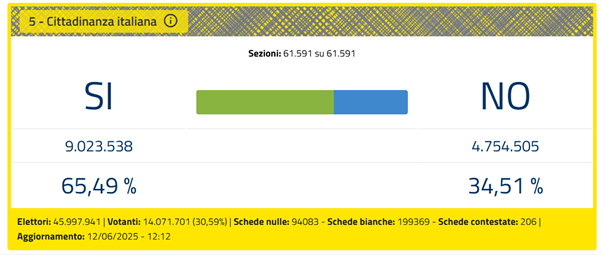
And this, as said, among the 14millions of people which are tendentially left-wing. This result was for sure counterproductive to the cause that referendum promoters were supporting and, I guess, no one in the next 10 to 20 years will try a reform of citizenship law. I’ll try to propose some reflection on referendum results. Why are Italians so conservatives?
To better understand the context of opinion in which the referendum on citizenship took place, we can look at survey data (SWG 2024). In the long run, meaning the last 25 years, we see that, in general, the attitudes of Italians towards immigration have changed for the better:
- the percentage of interviewees who consider immigration a resource for the country has increased (from 41% in 1998 to 57% in 2023, albeit with ups and downs)
- On the other hand, even the narrative of immigrants as a source of job insecurity for Italians (“they steal our jobs”) is no longer as convincing as it once was: if in 1998 54% of interviewees believed that immigrants took away job opportunities from Italians, in 2023 the percentage dropped to 32.
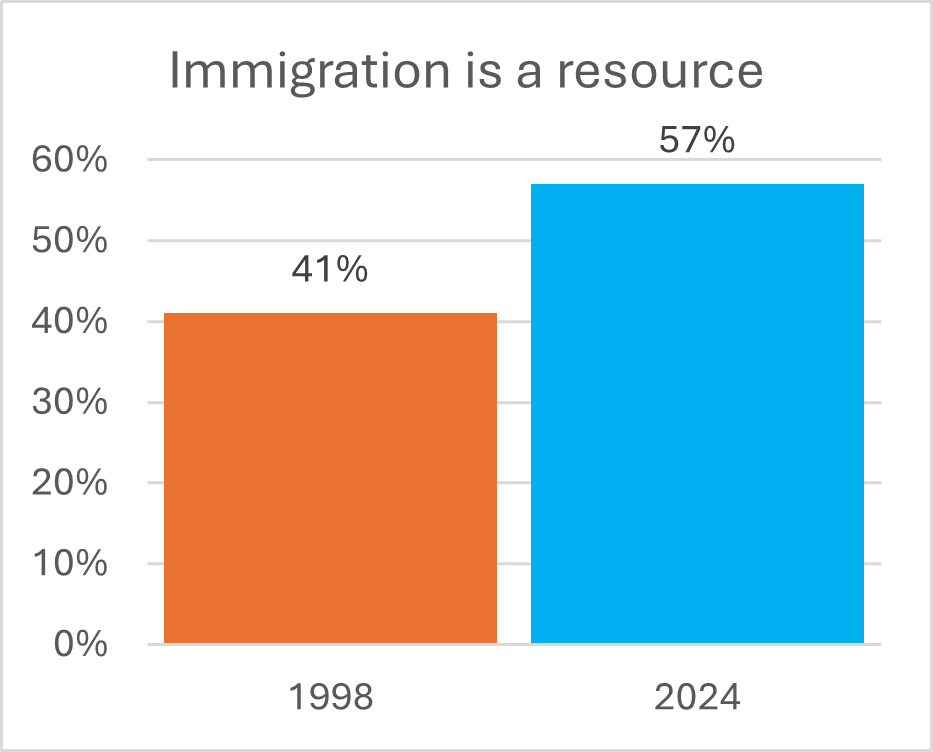
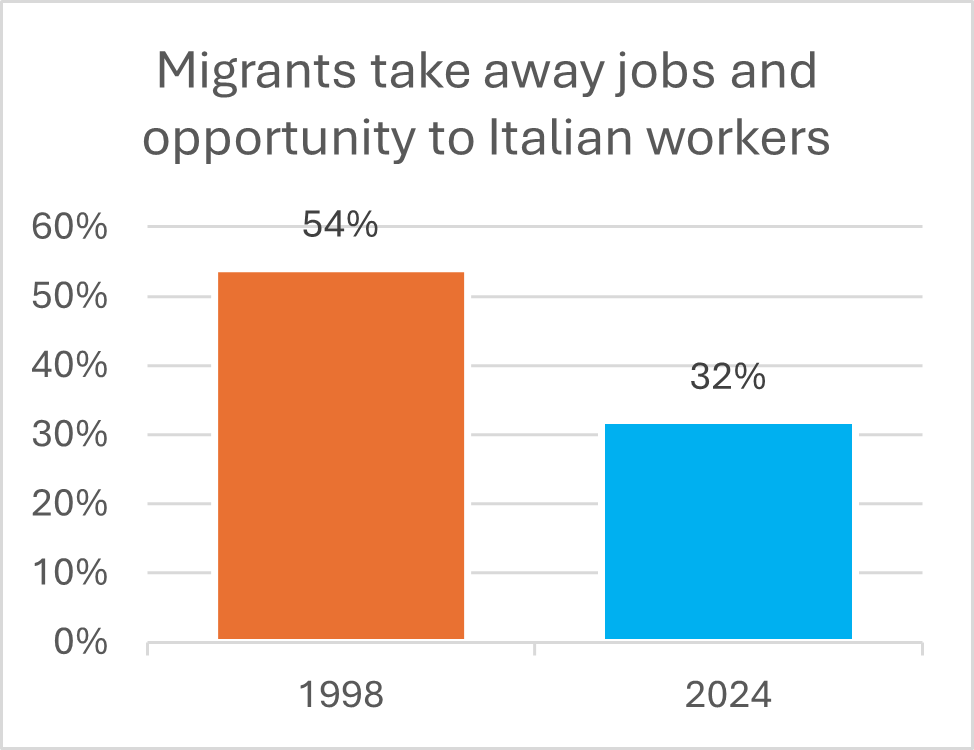
Source: SWG (2024), Africa e immigrazione: https://www.swg.it/pa/attachment/6683c18318760/Radar_24%20-%2030%20giugno%202024.pdf
Looking at Eurobarometer data, we at ISMU have noticed that a paradox has been present for many years now: immigration is widely perceived as a collective problem to which Member States must respond, but it does not seem to have priority at the individual level. So, if you ask citizens “Which are the top 2 priorities facing your country?” immigration is often mentioned, but if you ask the same people “Which are the top 2 priorities you are facing?”, immigration is not mentioned or less frequently mentioned. And this is true across the EU.
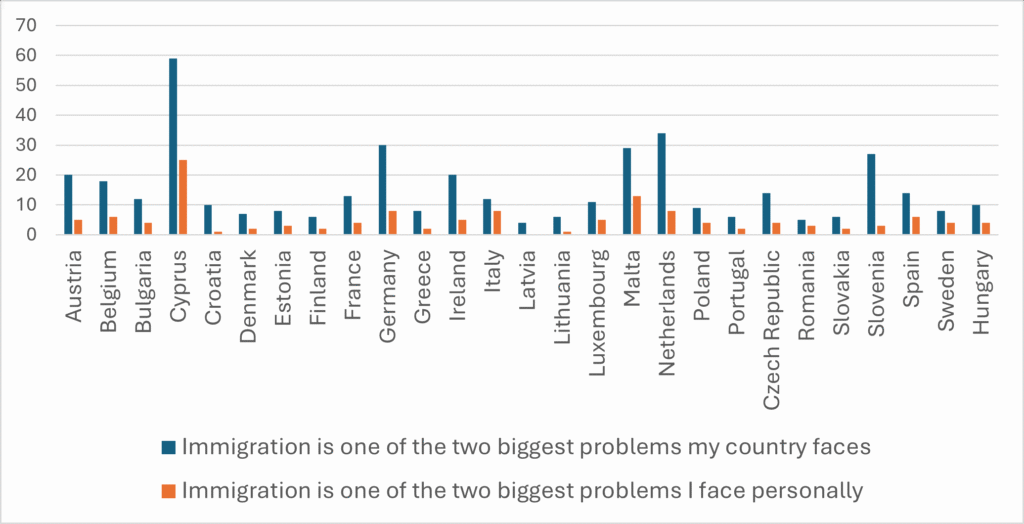
What can explain this contradiction? We can hypothesize that, here, 2 prominent actors shape the way public opinion sees immigration: mass media and political parties.
- On the one hand, mass media, due to their intrinsic ways of functioning, tend to frame the phenomenon by overexposing negative events, which often arouse more interest than stories with happy endings.
- On the other hand, politicians (mostly right-wing, nationalist, xenophobic, etc.), for their own interest, tend to ride sensationalism and use it to frame programmatic points around which to play their role in the political arena.
To this, we can add that policy responses are often insufficient.
So, immigration continues to be perceived as a problem despite most interviewees, in Italy and in Europe, believe that migrants are a resource. From a political science point of view, ISMU made a reflection on 2024 European elections and already there we could see how the issue related to citizenship was difficult to face. Not only because right-wing, nationalist and xenophobic parties convinced a large part of the electorate, but also because part of the centre-left electorate thinks that immigration could take away acquired rights (especially in the welfare state) from Italians.
Marta Regalia, Europe and Third Countries Department