
The numbers have also slightly increased in 2024. Germany, Spain, France and Italy are the main host countries
On World Refugee Day the ISMU Foundation highlights that, according to Eurostat data, over 1 million asylum seekers applied for international protection for the first time in in EU member states in 2023, a 20.1% increase compared to 2022. In addition, 75,290 applications referred to asylum seekers who had previously submitted another application, a -6.7% decrease in the EU compared (80,705) but also a +69.1% increase in Italy (53,365) compared to 2022.
As indicated in the UNHCR Global Trends 2024 Report, the overall number of forcibly displaced people in the world has reached 120 million in May 2024 and has grown for the 12th consecutive year due to old and new conflicts.
The main EU host countries are Germany (31.4%), Spain (15.3%), France (13.8%) and Italy (12.4%, i.e., almost 131,000 first-time applicants). As for nationalities, the largest number of asylum applications were submitted by Syrians, Afghans, Turks, Venezuelans and Colombians who together represented nearly half (48.0%) of all first-time asylum seekers in the EU in 2023. Since 2013, Syria has continued to be the main country of origin of asylum seekers in the EU, while Afghanistan was the second country for the sixth consecutive year (100,935 in 2023, i.e., 9.6% of the total number in the EU).
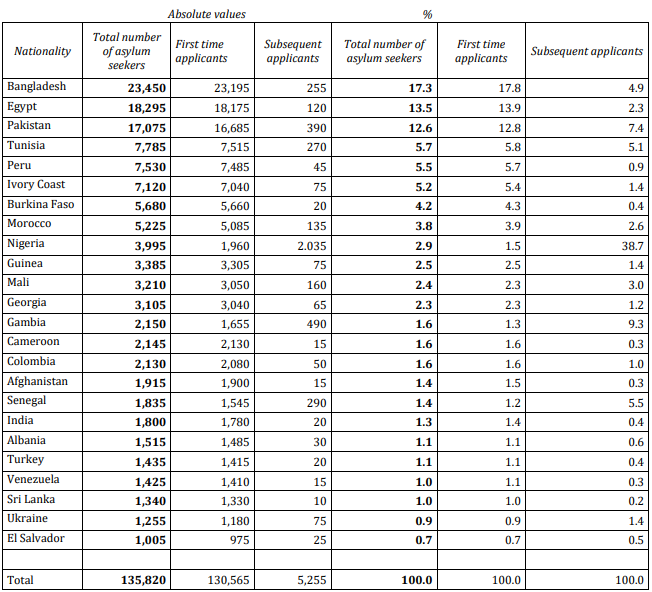
Asylum seekers in Italy mainly come from Bangladesh, Egypt, Pakistan, Tunisia. In 2023, unlike in the rest of the EU, Syrians, Afghans and Venezuelans were not the main nationalities among asylum seekers in Italy as they only represented less than 2% of applications. Most of requests came from Bangladeshis, Egyptians, Pakistanis (these three groups accounted 43% of the total number of applications), Tunisians, Peruvians and Ivorians.
For almost two years, Egypt and Tunisia have been among the main countries of origin of irregular migrants arriving to the EU via the Central Mediterranean route. This is also due to the internal socio-economic situation negatively affected by the economic crisis and exacerbated by various geopolitical events, such as the impact of the Russian invasion of Ukraine on the grain value chain, high inflation in 2022-2023 and, more recently, the conflict between Israel and Hamas and its consequences on stability regional. Civic space and respect for human rights are also deteriorating in both countries. Between 2023 and 2024, the EU concluded bilateral agreements with both Tunisia and Egypt to enhance cooperation between the two sides of the Mediterranean in various sectors, including the management of regular migration and the fight against irregular migration.
The limited presence of Syrian, Afghan and Turkish asylum seekers in Italy, however, can also be explained by the fact that these migrants can access better integration opportunities in Germany. Syrians, Afghans and Turks have indeed always preferred this destination and, over time, the presence of people from these three countries who are well integrated into German society has contributed to creating an attractive context for additional migration flows.
Asylum seekers in Italy by nationality (rounded to the nearest 5), 2023
 Source: ISMU processing of EUROSTAT data
International protection in Italy and in the EU. According to Eurostat data, 410,000 asylum seekers were granted international protection in the EU – 43% received refugee status, 35% subsidiary protection and 22% humanitarian protection. In 2023, the majority of beneficiaries of international protection in the EU were Syrians (32%), Afghans (18%) and Venezuelans (10%).
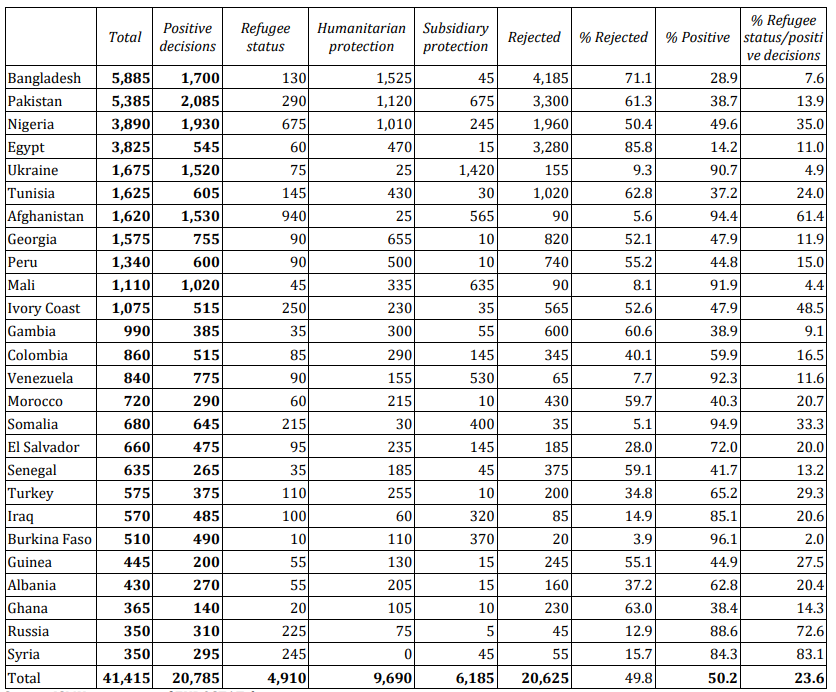
In Italy, 41,415 applications were examined and protection was granted to half (50%) of applicants. The refugee status was granted in 24% of positive cases, with a lower incidence than in the EU. In Italy what prevailed was the humanitarian/special protection (foreseen only in some national legislation), that was granted in 47% of positive cases.
The differences in the type of protection granted are evident in relation to the nationalities of applicants: refugee status was granted mainly to applicants from Syria, Afghanistan and Russia; subsidiary protection to applicants from Ukraine, Burkina Faso, Venezuela, Somalia and Mali and humanitarian protection to applicants from Bangladesh, Egypt, Georgia and Peru.
Rejected applications mainly concerned applicants from Egypt, Bangladesh, Pakistan, Tunisia and the Gambia. Differences in treatment based on nationality can be explained by the fact that the decree of 17 March 2023 controversially indicated Gambia and Tunisia as safe countries. This meant that applicants could be granted international protection only by providing evidence that they had been the target of personal persecution, which is not easy to prove and had an impact on the chances that applications would be accepted. With the decree of 7 May 2024, Bangladesh and Egypt were also designated as safe countries.
Decisions on applications for international protection in the EU, 2023
Source: ISMU processing of EUROSTAT data
Applications for international protection in 2024. In February 2024, 75,445 first-time asylum seekers applied for international protection in the EU, a nearly 2% increase compared to February 2023 (74,295). In addition, 7,000 subsequent applicants were also registered, an increase of 7% compared to February 2023 (6,540).
Syrians, Afghans and Venezuelans remain the largest groups of asylum seekers. In particular, Syrians remained the largest group in February 2024 (10,465 first-time applicants) followed by Afghans (6,950) and Venezuelans (5,800).
Germany, Spain, Italy and France host 75% of all first-time asylum seekers. In particular, Germany hosts 19,490 asylum seekers, Spain 13,600, Italy 13,345 and France 10,205.