
the project
RISE
Responsible Involvement in Society and Elections
The project “RISE: Responsible Involvement in Society and Elections” aims to tackle disinformation narratives and build civil society resilience

The project “RISE: Responsible Involvement in Society” aims to tackle disinformation narratives and build civil society resilience on the salient issue of the acquisition of Italian citizenship by foreign citizens, providing civil society, new citizens, young citizens (18-29 years old), journalists, and researchers with adequate information and tools to fight disinformation and polarization. Main objectives
- Empower Italian citizens to exercise their right to vote in the “Citizenship Referendum” by providing comprehensive and accurate information.
- Bring the debate and discussion to the European level on the acquisition of citizenship.
Hightlights
Towards overcoming familism in the Italian citizenship framework
In 2024-2025, there have been several developments regarding the Italian citizenship framework as defined in 1992 by Law No. 91. Specifically, reference is made to the so-called ius scholae proposals presented in the second half of 2024, and, regarding 2025, to the innovations introduced with Decree-Law No. 36 of March 28, converted with modifications by Law No. 74 of May 23, as well as the referendum held on June 8-9.
In this context, it seems useful to reconstruct how, starting from 1992, the Italian regulation concerning the ways to acquire citizenship has been modified. ⌈…⌉
Ennio Codini, Head of Legislation Department
Towards overcoming familism in the Italian citizenship framework
On June 8-9th, Italy held 5 referenda, one of which asked Italian citizens to review the rules on the naturalization of non-EU citizens. The question regarding citizenship aimed to modify the art. 9 of Law no. 91/1992 facilitating the naturalization of foreigners who today can only apply after 10 years of legal and uninterrupted residence. . ⌈…⌉
Marta Regalia, Europe and Third Countries Department
How
It will do so by promoting a collective debate and reflection among researchers, experts, journalists, and citizens with the right to vote in the proposed referendum to reform the law on the acquisition of citizenship in Italy.
When
RISE will empower Italian citizens, including new citizens, young citizens aged 18-29, journalists, researchers, and the broader civil society, to exercise their right to vote in the Citizenship Referendum, which will take place on June 7-8.
By providing comprehensive and accurate information through an awareness-raising campaign and online debate, the project expects to bring the debate to the European level, involving in the discussion experts and key stakeholders from other EU countries who will engage in comparative discussions on citizenship and methods of acquisition. Furthermore, the information campaign will constitute a key opportunity to raise awareness among citizens about citizenship.
From May to November, 2025
The activities
Create a webpage on the Fondazione ISMU ETS website containing a collection of informative documents covering statistical, sociological, political, and legal contexts related to citizenship and the referendum. The intent is to provide useful information so that all citizens can participate in the referendum with confidence and clarity. The webpage will contain contents and contributions collected by multidisciplinary experts and researchers
Organize an online debate seminar, featuring experts and stakeholders with diverse profiles, to discuss the importance of voting and the implications of the referendum. The seminar will also be launched through a dedicated press release informing journalists and civil society about the information campaign implemented by ISMU ETS.
Draft an online paper analyzing the outcomes and implications of the referendum, including a comparison with other European countries regarding practices for citizenship acquisition. The document will include 2 infographics to ensure the widest dissemination and accessibility of the contents.
Organize a final webinar to present the findings of the project, including a comparison with what is happening at the European level. The webinar is intended for an audience of 50 people, including experts, key stakeholders, and interested citizens. The final webinar will be disseminated through a newsletter.

This paper offers an analysis of the concept of “citizenship”, with particular reference to the Italian case and the referendum, from an interdisciplinary perspective.
Index
1. The RISE Project: Responsible Involvement in Society and Elections
2. Current legislation on Italian citizenship
3. A comparative perspective on the EU
4. What does it mean to be a citizen?
5. Concluding remarks
The first webinar
Verso il Referendum sulla cittadinanza.
Non quanti, ma quando e perché?
26 maggio 2025, ore 12.30
Information: comunicazione@test.ismu.org
press release
Italian Citizenship: Reflections and Data Ahead of the Referendum on June 8–9
Milan, May 26, 2025
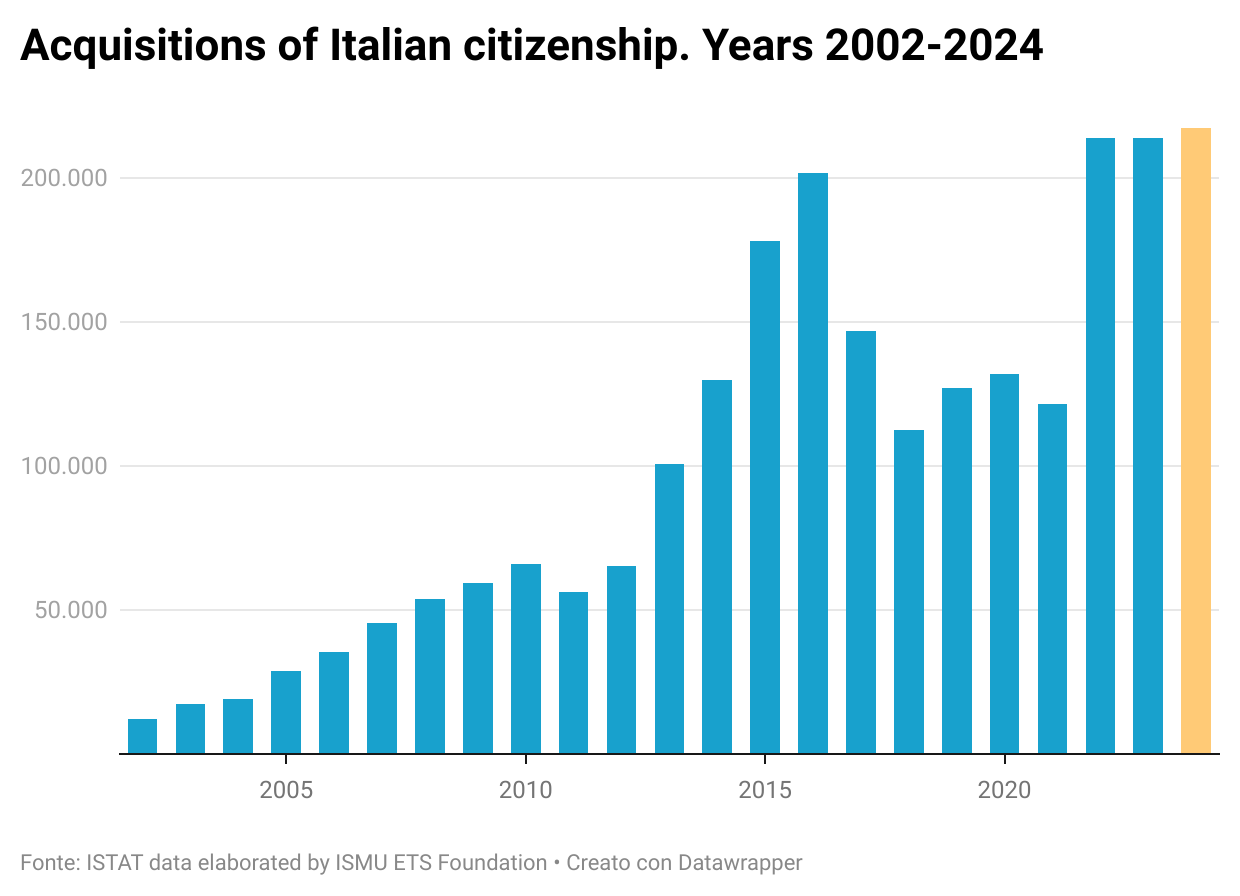
Over 217,000 individuals with a migrant background acquired Italian citizenship in 2024. This is highlighted by ISMU Foundation, which also notes that, according to the latest Istat data, for the third consecutive year, acquisitions of Italian citizenship have exceeded 200,000.
But how much do we really know about citizenship? What data truly matters? What biases influence the debate on this issue in Italy? And what are the positions of political parties in our country? These questions were discussed on May 26, from 12:30 to 2:00 pm, during the webinar Towards the Citizenship Referendum: Not How Many, but When and Why?, organized by ISMU ETS Foundation in preparation for the June 8–9 referendum, when voters will decide on possible changes to the acquisition of Italian citizenship by individuals with a migrant background.
The webinar, organized as part of the “RISE: Responsible Involvement in Society and Elections” project – which aims to counter false narratives and provide accurate information and tools to fight disinformation – featured the participation of: Nicola Pasini, Secretary General of ISMU Foundation; Sara Morlotti, Researcher in the Legislation Department of ISMU Foundation; Giorgia Papavero, Researcher in the Statistics Department of ISMU Foundation; Sumaya Abdel Qader, writer and sociologist. The discussion was introduced and moderated by Ennio Codini, Head of the Legislation Department at ISMU Foundation.
In preparation for the referendum, the ISMU ETS Foundation has also dedicated a section of its website to analyses, commentary, and reflections on the topic of granting citizenship to people with a migrant background (italian page https://test.ismu.org/referendum-acquisizione-cittadinanza). The section also includes an anonymous quiz to test your knowledge.
Below are some key data points shared and analyzed during the webinar.
An increase in Italian Citizenship Acquisitions
Based on Istat data from 2002 to 2024 (with the most recent figures being provisional), there has been a new increase in the number of Italian citizenship acquisitions by individuals with a migrant background: in 2024, there were 217,117 such acquisitions. For the third consecutive year, the number has exceeded 200,000. The past three years have recorded the highest figures ever.
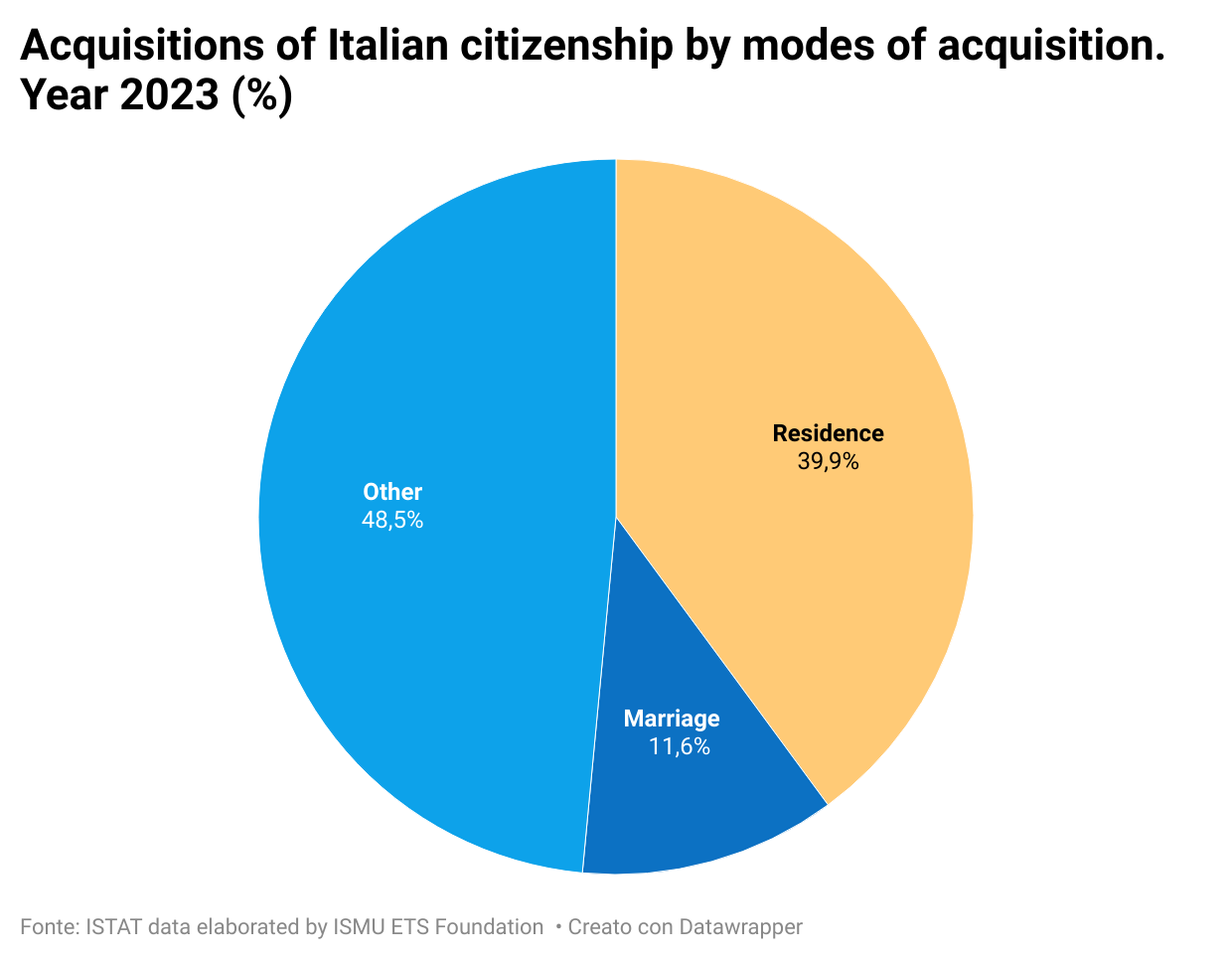
How Italian Citizenship was acquired. Istat data for 2023 shows that just under half of new Italians acquired citizenship through means other than residency, including: transmission of citizenship to minors by parents who became Italian, the choice made by newly turned 18-year-olds born and residing in Italy who become citizens upon reaching adulthood and ius sanguinis (citizenship by descent from Italian ancestors).
Meanwhile, 40% acquired citizenship through residency or naturalization – after 10 years of continuous legal residence (5 years for refugees and stateless persons, 4 for EU citizens). The remaining 12% acquired citizenship through marriage to an Italian citizen.
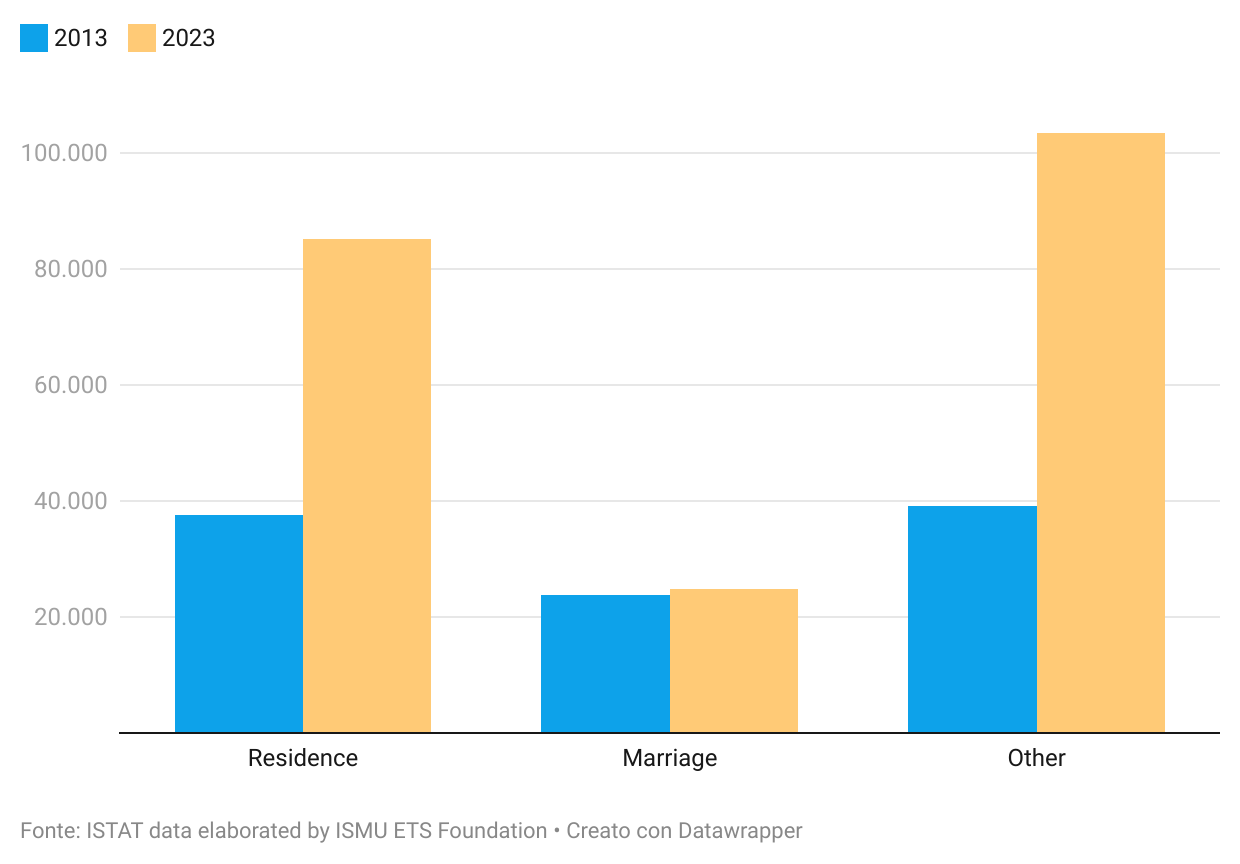
Over the past 10 years, the number of people acquiring citizenship through transmission, choice at age 18, and descent has nearly tripled: from 39,000 in 2013 to over 103,000 in 2023. Naturalization involved 85,000 people in 2023, marking a 127% increase since 2013. The number of new citizens through marriage has remained relatively stable (around 24,000 annually), but its share of total acquisitions has dropped from 24% to 12% in 2023.
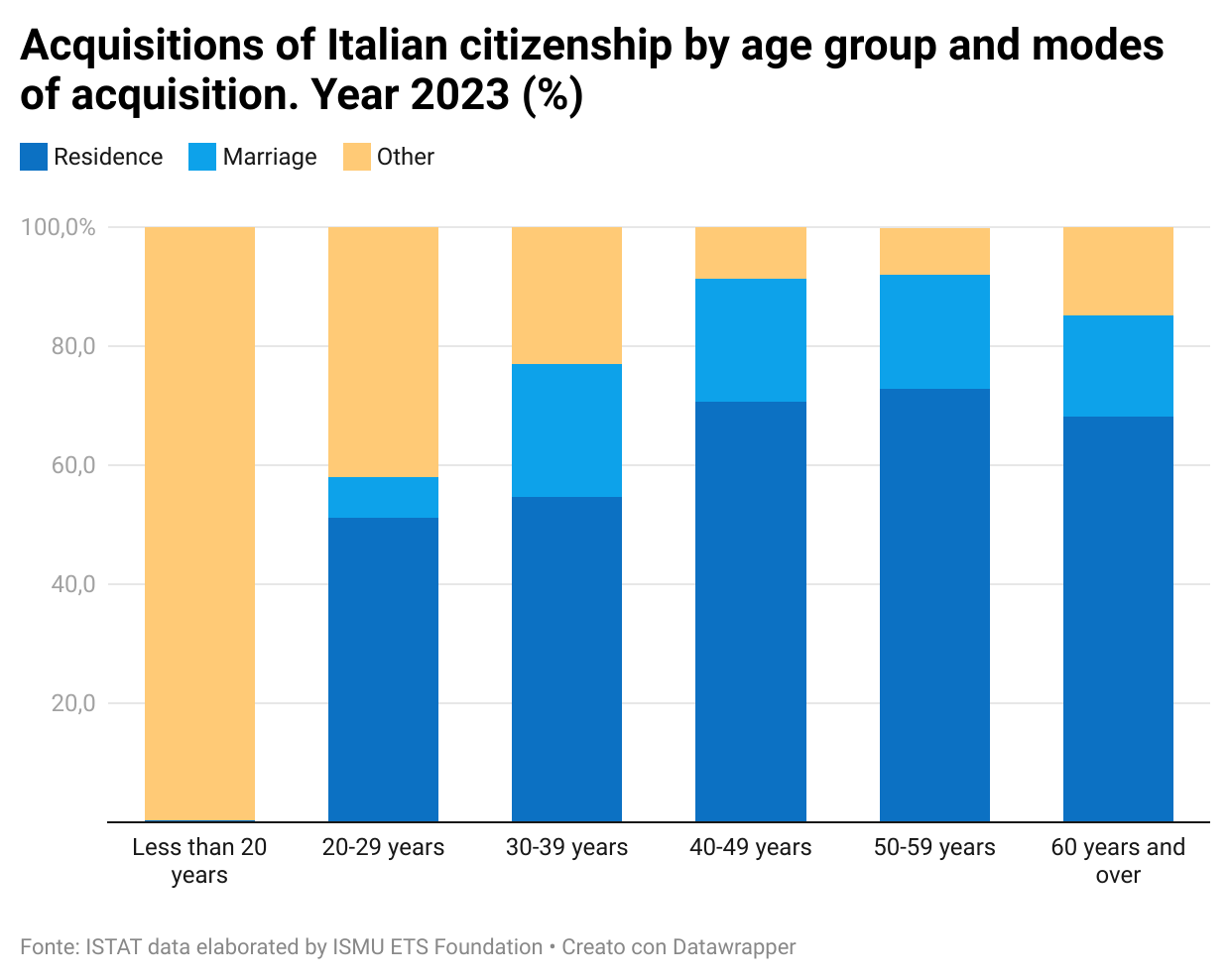
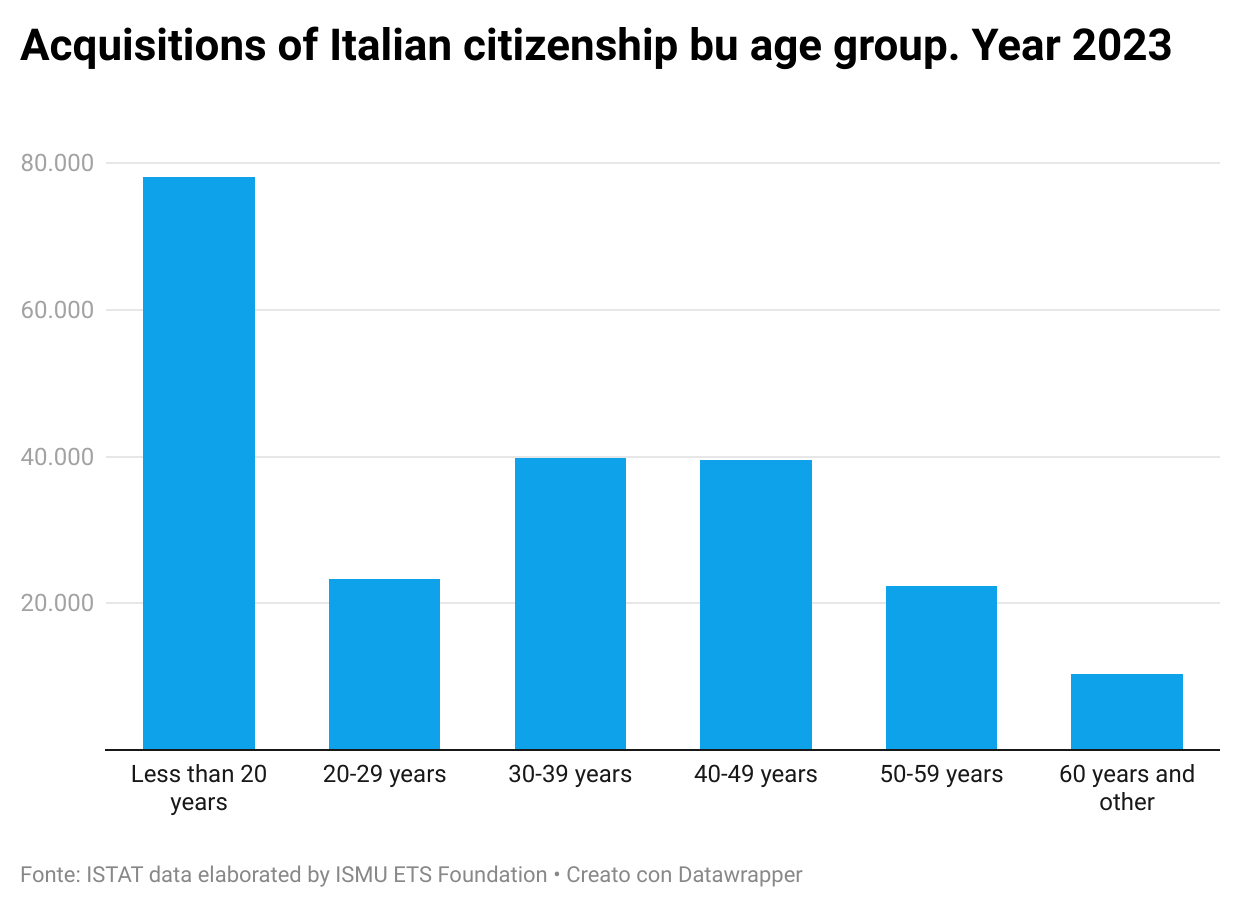
A Young Population of New Italian Citizens. 48% of new Italian citizens are under 30. Those aged 20 or younger represent the largest group, with over 78,000 citizenships granted in 2023 – accounting for 37% of all acquisitions. Among those under 20, the most common paths to citizenship are transmission from parents and the choice at age 18. For older age groups, residency is the main channel – around 70% of those over 40 were naturalised according to this procedure. Among those over 60, 15% acquired citizenship through Italian descent (ius sanguinis).
The Webinar. These are some of the key data points that were analyzed during the webinar organized by ISMU Foundation. The main issues were explored in depth, and answers were provided to some frequently asked questions, helping participants approach the upcoming vote well-informed.
Program
TOWARDS THE CITIZENSHIP REFERENDUM
Not How Many, but When and Why?
May 26, 12:30–2:00 PM
Moderator and Introduction: Ennio Codini
· How much do we really know about citizenship? Sara Morlotti
· What are the key facts? Giorgia Papavero
· What biases influence the debate? Sumaya Abdel Qader
· What are the political parties’ positions? Nicola Pasini
Discussion and Debate
Charts

This project receives funding by European Citizen Action Service (ECAS) in the framework of the EURECA 2025 project, which is co-funded by the European Union. Views and opinions expressed are however those of the author(s) only and do not necessarily reflect those of the European Union or ECAS. Neither the European Union nor ECAS can be held responsible for them.