
On June, 8th and 9th, Italian citizens are called to the polls to reveal their idea of citizenship. In a changing world, in which climate change, globalization processes and related socioeconomic changes have made people extremely mobile and national borders more permeable, Italians will have to decide, in a repeal referendum, whether and how to review the rules on the naturalization of non-EU citizens.
The question regarding citizenship aims to modify the art. 9 of Law no. 91/1992 facilitating the naturalization of foreigners who today can only apply after 10 years of legal and uninterrupted residence. In the event of a victory for the “yes” votes, the time frame would be halved and the acquisition of citizenship would therefore be facilitated for many adult foreigners (and consequently also for their cohabiting minor children, who would become citizens with the naturalization of their parents). The other requirements required by law (income, absence of criminal record, knowledge of the Italian language) would remain unchanged.
In this short writing we want to analyze:
1) The importance of the immigration issue among the Italian and European population
2) The latest opinion polls regarding participation
3) The positions of the parties towards the referendum
1) The importance of the immigration issue
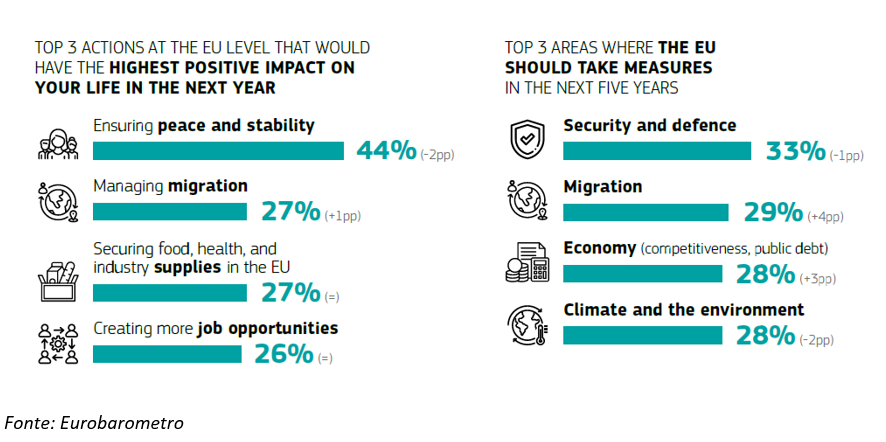
To better understand the context of opinion in which the referendum on citizenship takes place, it is possible to use Eurobarometer data, which represents the best source of information relating to the opinions of citizens of the Member States of the European Union. Built by interviewing significant samples of citizens from the 27 states, the EB regularly monitors the state of public opinion in Europe on issues relating to the European Union, as well as orientations on topics of political or social nature. Data from the latest version, published in November 2024, shows that, at a European level, immigration represents the second priority that the EU should address in both the short and long term, cited by 27 and 29% of respondents respectively, immediately after security.
Fig. 1. Priority actions at European level
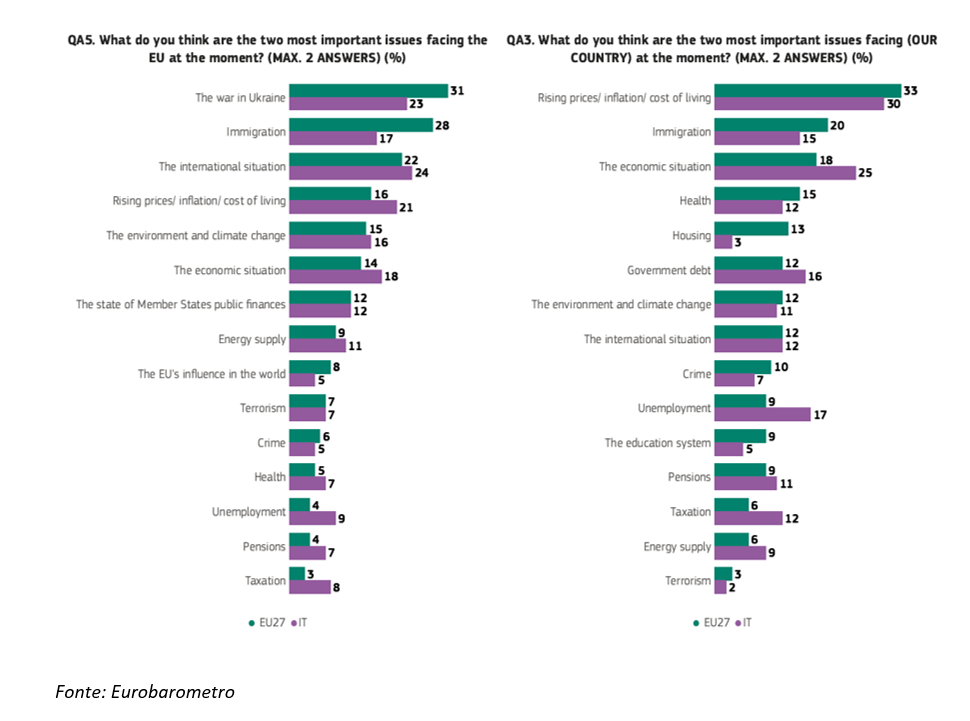
If we look at our country (Fig. 2), we see that Italians attribute less importance to issues related to migration than Europeans as a whole: if, in fact, 28% of Europeans cite immigration among the two most important issues that the EU must face, second only to the war in Ukraine, Italians see the international situation, the war in Ukraine, inflation, the economic situation and, only in fifth place, immigration as priorities. The same can be said for the two most important issues that your country should address: for Europeans, immigration is in second place, after inflation; for Italians it is in fifth place, after inflation, the economic situation, unemployment and public debt.
Fig.2. Issues that the EU and Italy should address as a matter of priority
2. Electoral participation
Based on the most recent survey carried out by Demopolis between 14 and 16 May, 46% of those interviewed declare that they are aware of the referendums, another 19% know that they will take place, but do not know what they will be voting on, and finally 35% have not heard of them. As regards electoral participation, only 30% of Italians say they will go to vote, while 56% say no, with 14% undecided. Assuming that these data, three weeks before the vote, are reliable, there would be no margin at the moment to reach the quorum of 50% plus one. The estimated turnout at the moment is in fact between 31% and 39%.
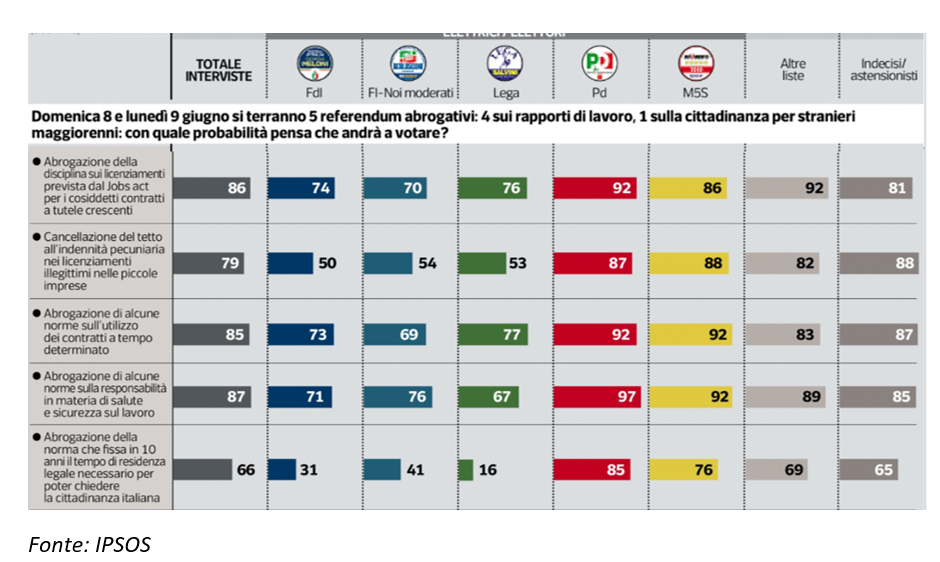
Finally, the IPSOS estimates show how the referendum on citizenship is the one with the lowest rate of potential participation (fig. 3): among voters of all parties, the propensity to vote for the referendum on citizenship is lower than other referendums that will take place on the same day. Among the voters of the government majority, only 31% of the Brothers of Italy voters, 41% of those of Forza Italia and 16% of those of the League say they will go to vote. Among the voters of the opposition parties, 85% of the voters of the PD, 76% of those of the 5 Star Movement and 69% of those of other parties will participate in the vote. As can be seen from figure 3, the percentages are lower than those found for other referendums within the electorate of all parties.
Fig.3. Percentage of respondents who declare they will vote for each of the five referendums
3. Parties’ stances
The referendum question on citizenship (one of the five on which Italians are called to express their opinion) sees the parties divided between the conscious abstentionism of the centre-right majority and a tangle of diversified positions in the centre-left.
Fratelli d’Italia, Lega and Forza Italia are against the proposal to halve the minimum period of legal residence required for a non-EU adult foreigner to apply for Italian citizenship. These parties have invited voters not to go to the polls to hinder the achievement of the quorum.
The positions of the opposition parties, however, are more diversified. Favorable parties are the Green-Left Alliance, the Democratic Party, Più Europa, Italia Viva, and Azione, Calenda’s party, which, while criticizing the use of the referendum tool, has announced that it will vote Yes. The 5 Star Movement has left freedom to their voters, but the president of the party, Giuseppe Conte, has declared that he will vote Yes.
Fig. 4. Parties’ stances
Yes
Alleanza Verdi-Sinistra
Partito Democratico
Più Europa
Italia Viva
Azione
No
Noi moderati
No indication
Movimento 5 Stelle
Abstension
Fratelli d’Italia
Lega
Forza Italia
Marta Regalia, Europe and Third Countries Department